Reach in the report, cars in the CRM
The agency reports impressions, the contracts live in another system. The question “which campaign sold these seven cars” hangs in the air — and that isn't negligence: the agency simply has no access to your CRM.
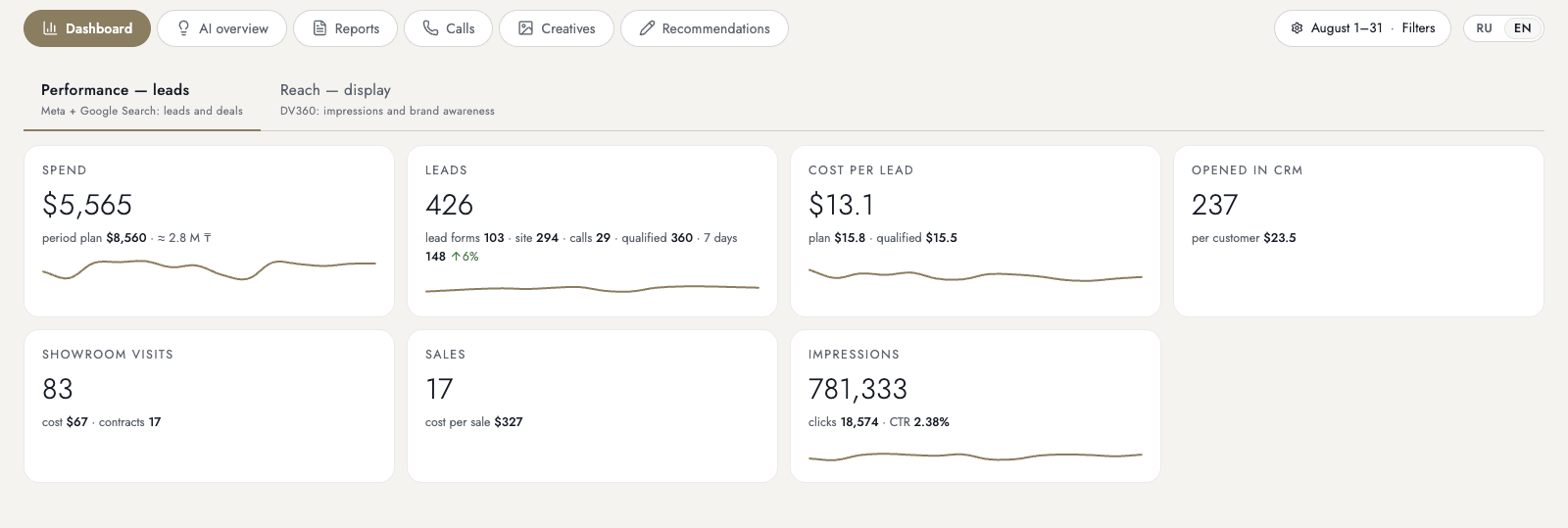
Spend by channel, every call with its recording and contracts from your CRM — in one report. It builds itself every day and doesn't break when someone renames a campaign in the ad account.
The demo is open by link — no sign-up, no salesperson. The data is made up.
Three places where money and time leak every month. Not one of them is fixed by another dashboard.
The agency reports impressions, the contracts live in another system. The question “which campaign sold these seven cars” hangs in the air — and that isn't negligence: the agency simply has no access to your CRM.
A missed call exists at the phone operator and nowhere else. Until calls like that sit in one log with response times, neither the sales manager nor the director sees them.
Five exports into one Excel file — and from scratch every month: the campaign structure changed, the formulas slipped, and it's still due by the third.
All of it is open in the demo right now — by link and without sign-up.
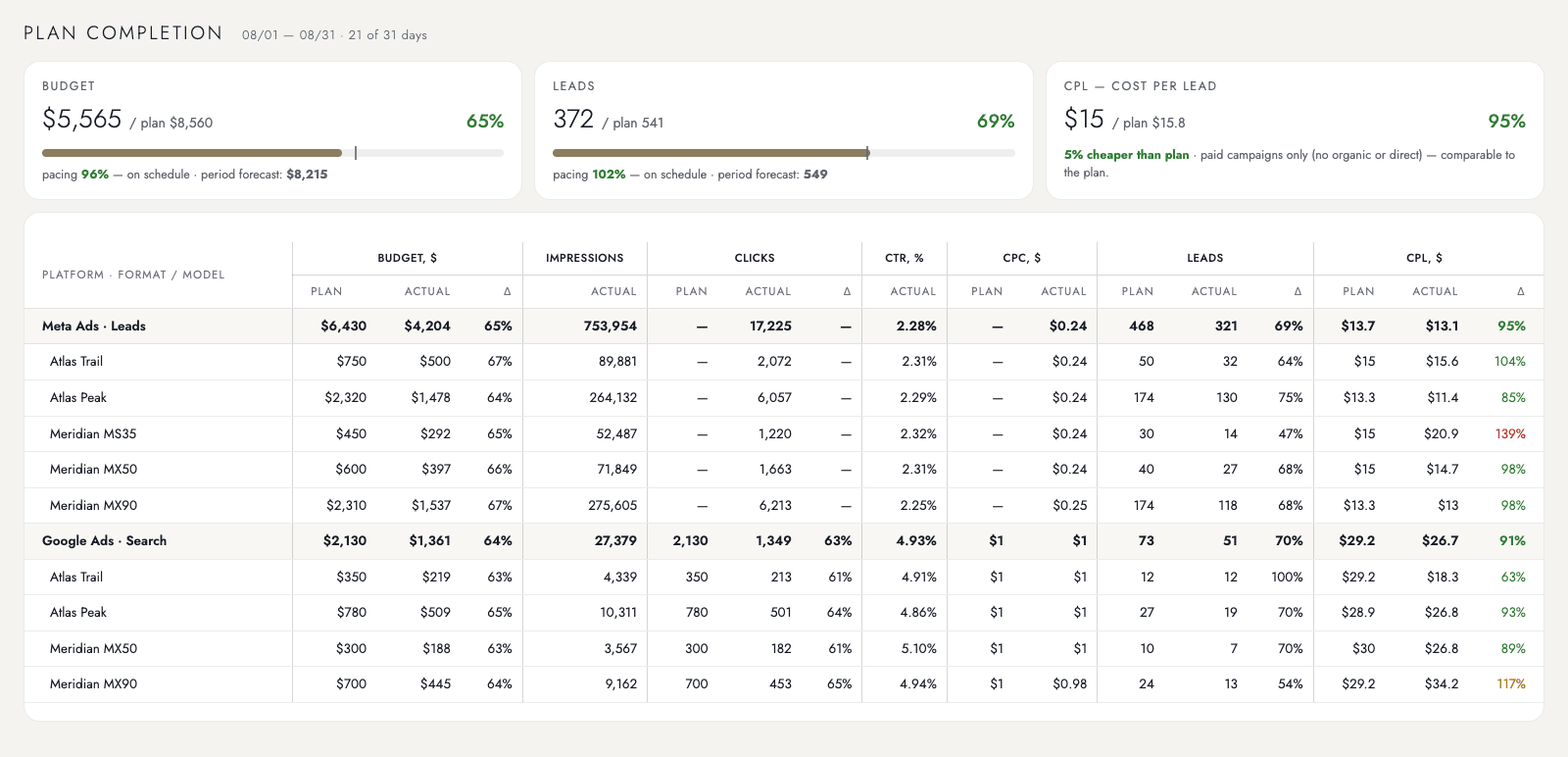
The media plan stays yours — the same rows you agreed with the importer: channel, brand, model, format. Next to them stand plan, actual, plan completion and pacing to the end of the period.
A campaign got renamed — the row isn't lost: matching runs on rules, not on names. And spend that fits no rule shows up as its own row the same day.
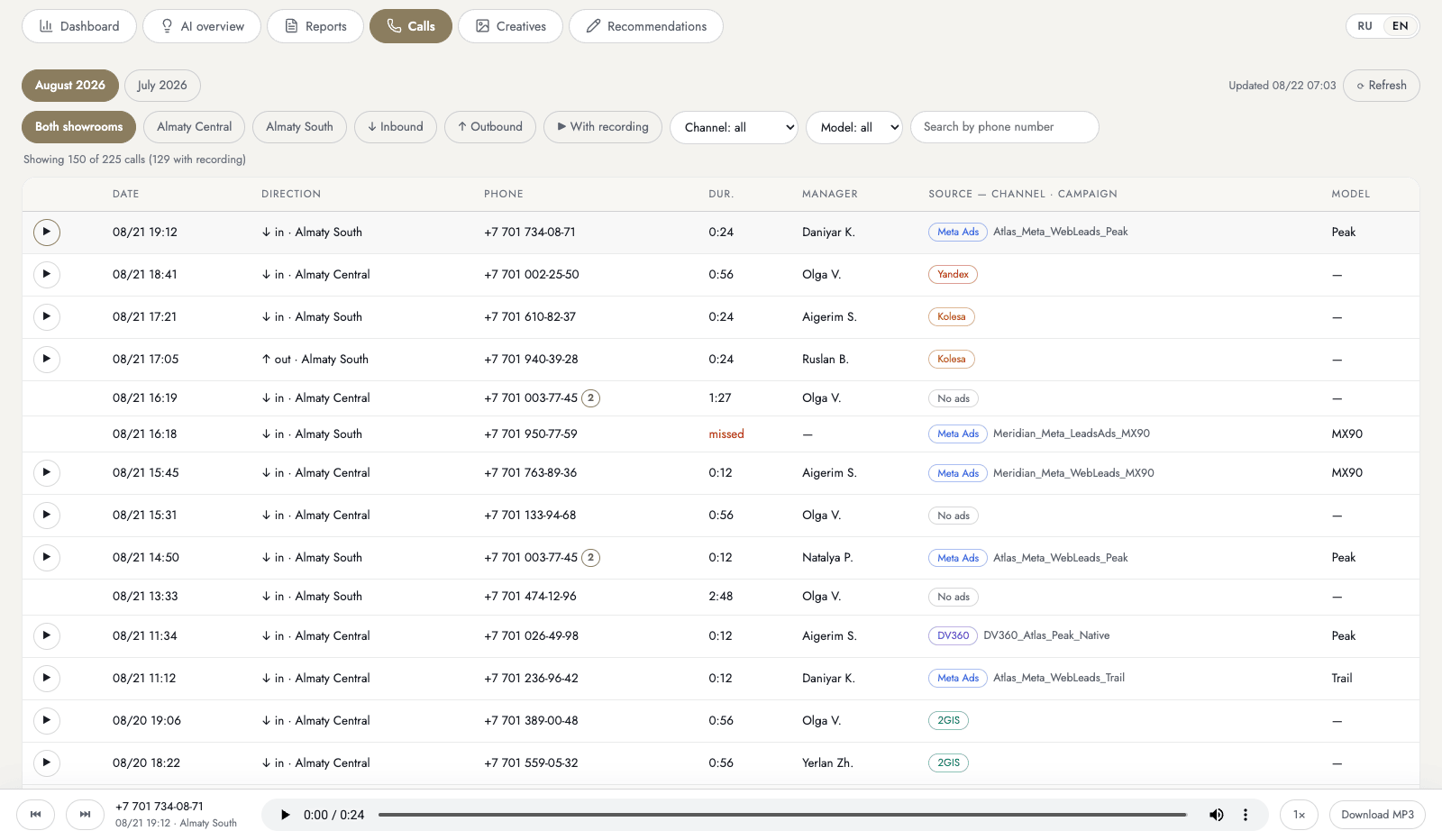
Where it came from, who answered, who never got a call back and how many hours later. Repeat calls from one number merge into a single lead — I tune the merge window to your methodology so the number matches the one you report to the brand.
The recording plays right here: no hunting for the conversation in the call tracking account by number and time.
As a separate option — transcripts: the text of the conversation next to the recording, automatic tags for objections and a summary per manager for the period. I don't keep the audio — I take the recording from the operator, transcribe it and keep only the text.
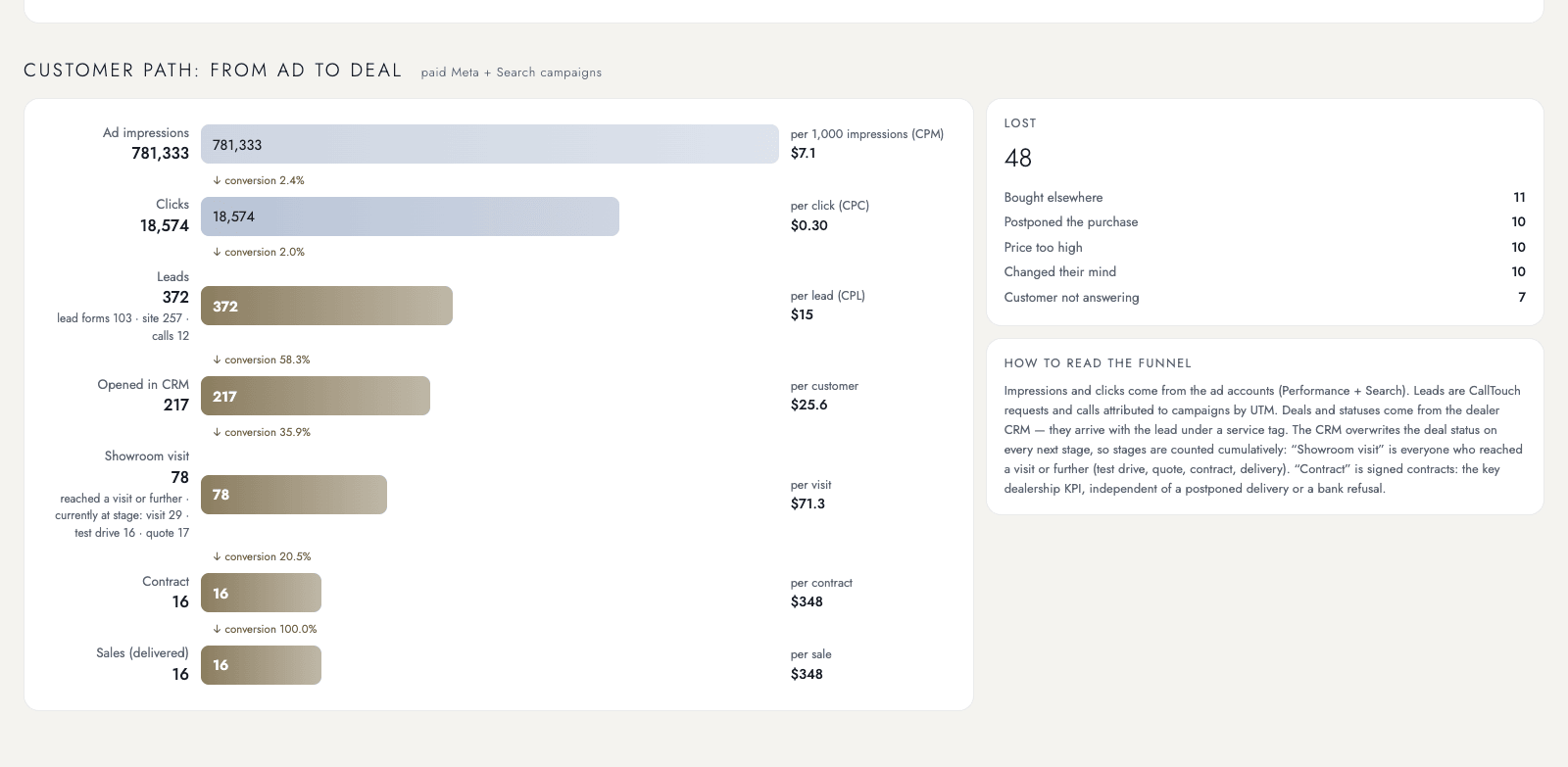
Impressions, clicks, leads, picked up, showroom visit, test drive, contract — with the cost of every step and a list of loss reasons. A dealership's result is a signed contract; that's what I count.
The stages here are yours: the report shows the funnel the way deals are entered in your CRM. If the data is kept sloppily, I'll say so and suggest what to fix — but the report stays a report on top of your sources, not a substitute for order in the CRM.
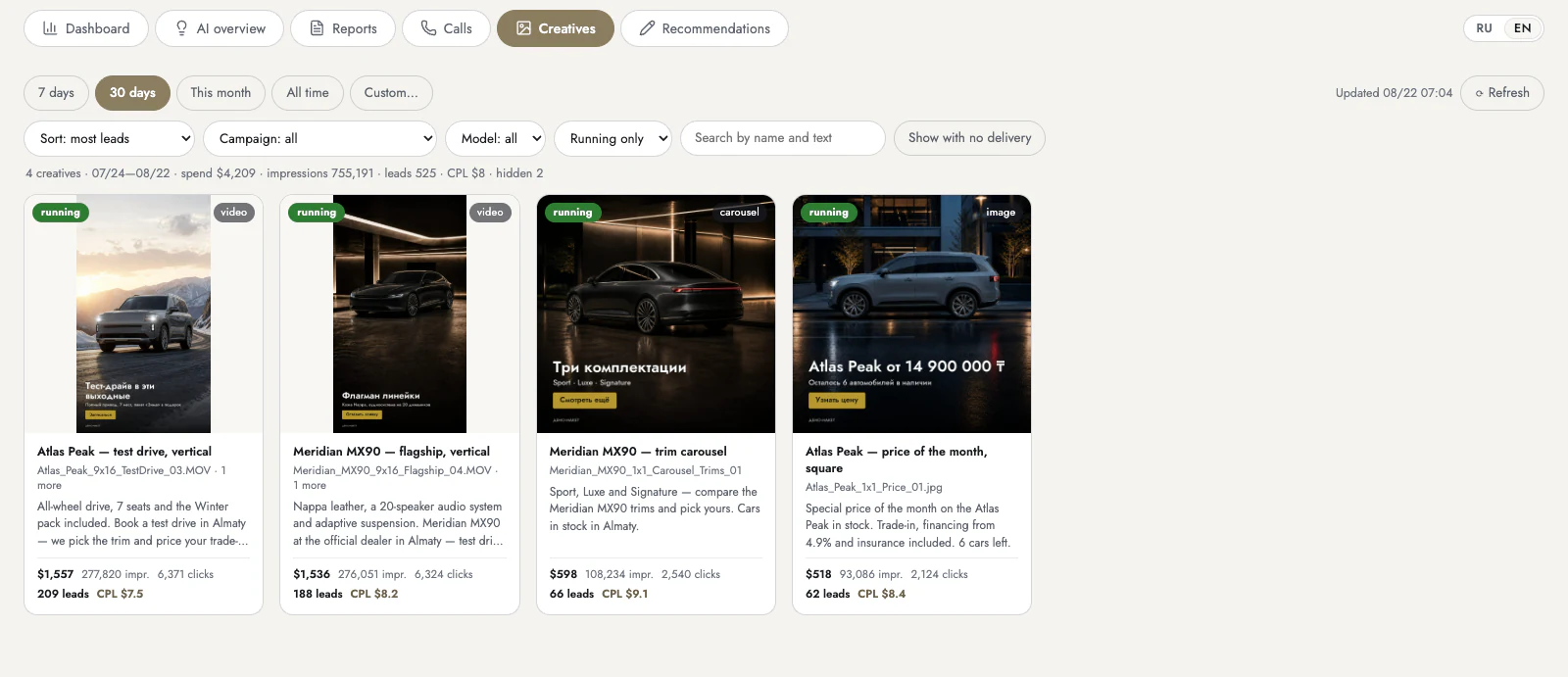
Live Meta ads stand next to their spend, leads and cost per lead: you see which creative works, which one runs without a single call, which one was stopped long ago.
Sorting by cost per lead settles the “what do we pull this week” question in a minute.
Every importer has its own report format and changes it several times a year. A machine that assembles it wrong is worse than a person who assembles it right. So this part I'm not automating yet.
How many calls and requests couldn't be found in your CRM. I count it on your data before we sign an agreement: naming a number blind is dishonest, and after onboarding it's too late.
I build it: instead of your day and a half to two days — an hour and a half of my work. A separate option, and you pay for exactly that manual work.
Don't want to open the report — once a week I write to you myself: spent, calls, how many never got a call back, sold. The system writes the text, I send it.
The first step is free and commits you to nothing: you'll decide on your own numbers, not on my presentation.
2 business days, free. No access needed: you send exports from the ad accounts and a list of calls.
What you already have is enough: Meta and Google spend for the month and the call log from your operator. I'll send back one page — how many leads never reached the CRM and how many people never got a call back — and we'll talk for half an hour.
1–2 weeks. Ad accounts read-only first, then call tracking and the CRM. It takes an hour or two of your time.
If the CRM only works inside the office, I need your system administrator for half a day: a small program goes on the server, it sends data out and takes nothing in. That's also when I set up the media plan and the model reference list.
I pull history as far back as your sources allow — much depends on the tracking tags that link rows from different systems. How much you'll get, I'll tell you at the audit, before we sign an agreement.
Once a week — a short digest by message. At the end of the month — the report.
A 30-minute call review is included in the plan — once a month.
No call tracking? I'll help you choose and connect it, but you buy the service itself from a phone operator: a direct agreement with them, at their price list. I don't resell call tracking, don't invoice for telephony and don't quote prices for it. Classifieds will show you views and taps on the number at their end, but not how the call ended; a billboard shows nothing at all. The only way to tie a call to a deal is a tracking number.
I charge not per user and not per volume of data, but per dealership or brand team: the second manager in the report costs nothing.
One showroom, one or two brands. The CRM works and deals are actually entered in it.
$279 / mo
One-time onboarding — $530
Monthly, or a year at 15% off — that's $502 saved over the year
Three to five brands, or several points of sale.
On request
Ballpark — from $529 a month, onboarding from $950
The price is fixed per network, not per location
The plan isn't the whole bill: in the first month the one-time onboarding is added to it. I name both numbers up front so the second one doesn't surface in the invoice.
| First month | Per month after that | |
|---|---|---|
| Dealer | $809 | $279 |
| Group | from $1,479 | from $529 |
Onboarding covers setting up the ad accounts and call tracking, building the media plan and the model reference list, connecting the CRM and the first month of support; with annual prepayment it costs half as much. Options on top of the plan: importer report — $129 a month (one brand is included in “Group”), call transcripts — $79 a month up to 1,000 calls, then $0.05 per call.
| Agency dashboard | Looker Studio | Otdacha | |
|---|---|---|---|
| Costs | $0, inside the retainer | $0 plus connectors and a person | from $279 |
| Calls with recordings inside the report | no | no | yes |
| Funnel down to the contract from your CRM | no access to the CRM | no | yes |
| Report in the importer's format | by hand | by hand | I build it |
| Stays with you when you change agency | no | yes | yes |
The table scrolls sideways →
The price is the same from me and from the official distributor — that's written into my agreement with them. Payment in dollars to the account of a sole proprietorship registered in Georgia; an invoice in local currency is converted at the official rate of your National Bank on the invoice date, which is printed on the invoice itself. There are no discounts off the price list: there is −15% for paying a year up front, and on “Dealer” that's $502 a year.
And I'm not suggesting you drop it. The difference comes down to two things.
And honestly: if you have neither call tracking nor a living CRM, the agency report is enough for you right now.
Count the full amount, not the subscription: $279 a month is my system, call tracking you buy separately from a phone operator at their price list.
The thing to compare it with isn't zero, it's what the calls nobody returned last month cost you. I'll count that for free in two business days — decide after that.
There are no discounts off the price list. There is −15% for paying a year up front.
Short version: I read, I don't write.
We sign a service agreement and a data processing agreement.
Nothing changes: the ad accounts are registered to you, the history stays with you. You give the new agency a view-only role, and from day one it sees the same numbers.
It's also the only way to compare the old agency and the new one on the same data instead of two different reports.
Call tracking is where we start: without it there's nothing to measure half your leads with. I'll help you choose and connect it, but the phone operator sells it — a direct agreement with them, at their price list. I don't resell this service and don't quote prices for it. The operator's bill depends on your site traffic, so it's worth checking the rate with them before onboarding.
You don't need a separate analyst: I connect and configure it, a short digest arrives once a week, and a call review once a month.
Because your main ad spend is already in dollars: Meta doesn't support local currencies. I name the price in the same currency you count advertising in.
For a paid period the price is locked: pay for a year and it doesn't change for a year. An invoice in local currency is converted at the official rate of your National Bank on the invoice date, which is printed on the invoice.
If the rate moves hard, the amount in local currency goes up even though I didn't raise the price. The only thing that works against that is annual prepayment at 15% off — it locks both the price and the rate.
amoCRM and Bitrix24 — directly. Dealer CRMs and 1C — through an export or through a connector inside your network. I'll connect any call tracking that has a call export and links to the recordings; if you don't have one, I'll pick one.
I don't promise “any system out of the box”. Tell me on the first call what you're running — I'll answer honestly, including “that one is beyond me”.
You can leave at any moment, paying for what's already been delivered: the annual agreement is a settlement format, not a way to hold on to you.
After that it depends on where the report is hosted. Hosted by me — access stops, you take your data with a one-click export, including the last day. On your own server — the report keeps working, only support and updates stop. The ad accounts, call tracking and CRM are registered to you either way.
Otdacha is an independent product, Mediagate is a sales channel and first-line support. Whichever way you buy, the account is registered to you.
The distributor sees exactly what it needs to work on your project. Wider access — for example, if its people run your advertising — is opened with your agreement. You can also buy directly from me, the price is the same: here is how it works.
I build the product, the distributor handles sales and first-line support. That's true, and it's exactly why everything is arranged so that you don't depend on me: response times are written into the agreement, all accesses are registered to you, data exports in one click. And if you need to remove the dependency entirely — the report can be deployed on your own server.
I work as a sole proprietorship registered in Georgia: the service agreement is in Russian, plus an invoice and a monthly acceptance act. What that means for your accounting — on the “How we work” page.
A last-month audit: two business days, free, no access needed — exports from the ad accounts and a list of calls are enough.
I'll answer within one business day and send you a list of three exports — nothing else is needed at this step. I write only in reply to your request: I don't run mailing lists.